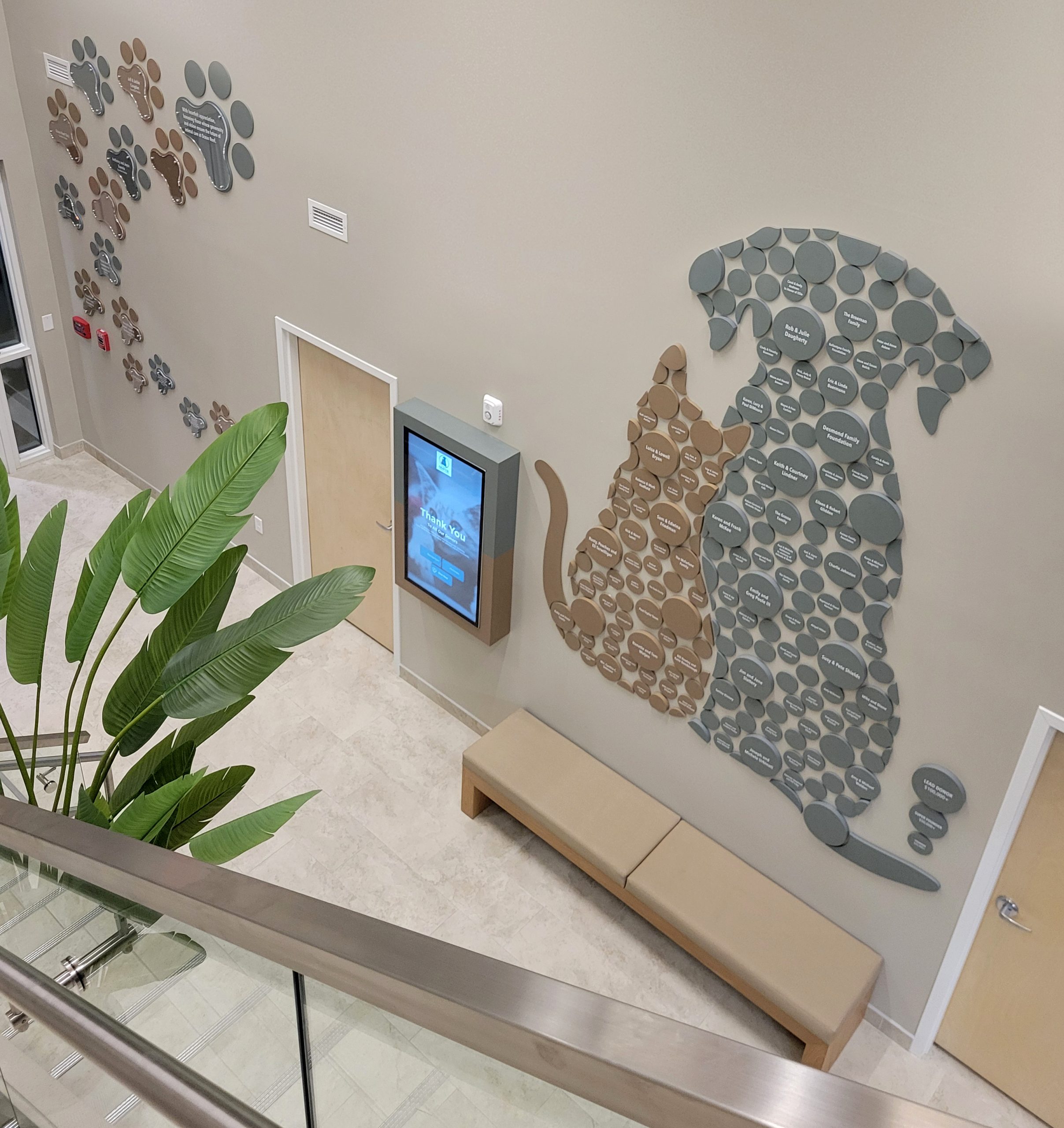
Donor Recognition Wall for ORCAT – Grayvik Animal Center
Client Overview
ORCAT – Grayvik Animal Center serves the Ocean Reef community in Key Largo, Florida, providing animal care, rescue, and adoption services. The organization operates in a highly visible, community-facing environment where donors are closely connected to the mission and expect recognition to reflect that connection. Their donor recognition wall played a key role in reinforcing that relationship, creating a tangible link between donor support and the impact of their contributions.
As part of a broader effort to strengthen donor visibility within the facility, ORCAT required a recognition approach that aligned directly with its identity while remaining practical to maintain and expand over time.
The Challenge in Creating this Donor Recognition Wall
The challenge was not singular. It was a combination of conditions that needed to remain in balance.
The donor base for this donor recognition display included a high volume of contributors at lower giving levels, creating potential density issues that could reduce readability and hierarchy. At the same time, the organization did not want a traditional panel or grid system.
The recognition concept required an organic silhouette – forming the shapes of a dog and a cat – which introduced placement complexity that could not rely on standard alignment methods. Every nameplate had to contribute to both the image and the recognition structure.
Future growth added another layer. The display needed to accept additional donors without requiring removal, reconfiguration, or visual disruption. This meant planning for expansion from the outset while still presenting a complete installation on day one.
The environment also included a digital display element, requiring coordination with electrical and data placement while maintaining visual balance with surrounding seating and circulation.
Throughout the process, revisions to layout, scale, and donor distribution continued to evolve. The solution could not depend on fixed assumptions. It needed to remain stable as inputs changed.
The Strategy
The solution required a system that could maintain alignment across all of these conditions without compromise.
Rather than separating recognition from form, donor names were used to construct the silhouette itself on this donor recognition wall. Individual discs of varying sizes represent giving levels, allowing hierarchy to exist within a continuous composition instead of across segmented panels.
Density was managed through distribution, while hierarchy was maintained through controlled variation in size and placement. This ensured that no area of the display functioned independently – each element contributed to the overall form.
Material and construction decisions supported legibility and consistency. Textured laminates and controlled contrast allowed names to remain readable without introducing glare or visual noise. Acrylic backers created dimensional separation, improving clarity between elements.
Expansion was addressed through overlay-based add-on components. Future donor names could be applied without removing or disturbing existing elements, allowing the system to grow while preserving the integrity of the original layout.
The Solution for the Donor Recognition Display
The final donor recognition wall is a layered recognition solution organized within the silhouettes of a dog and a cat.
From a distance, the forms are immediately recognizable and aligned with the organization’s identity. At closer range, individual donor names become the focus, supported by a clear hierarchy established through size and placement.
The composition avoids the appearance of a fixed grid while maintaining order and readability. Variations in depth and spacing create structure without requiring rigid alignment.
A digital display is integrated within the installation, providing an additional channel for recognition and storytelling while remaining visually connected to the overall system.
It reads as complete at installation while maintaining capacity for future growth.
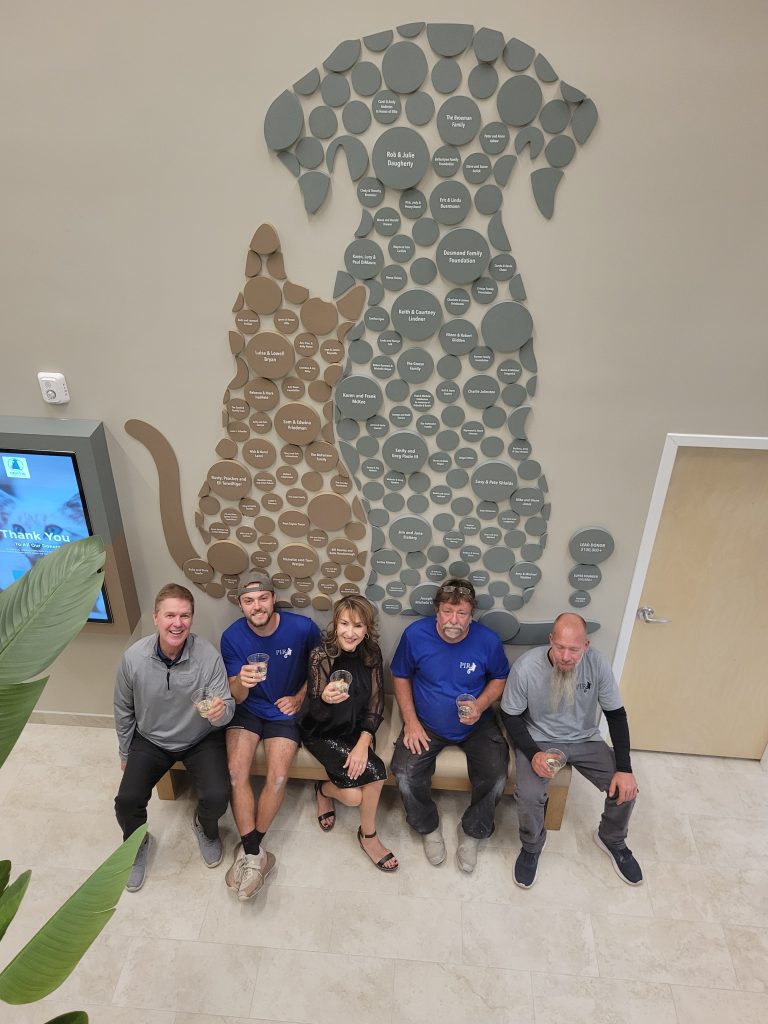
Execution
Execution required translating an organic design into a repeatable and controlled installation process.
Full-scale templating established precise placement for every element, ensuring the silhouette remained consistent and repeatable across the entire installation. This approach removed reliance on field adjustment and reduced installation risk.
Mounting methods combined mechanical fastening with adhesive techniques to maintain alignment and stability while preserving a clean visual finish.
Coordination with electrical and data requirements ensured proper integration of the digital display, including access and ventilation, without disrupting the composition.
Revisions were incorporated through controlled iteration, not deferred to installation. Adjustments to scale, spacing, and material application were resolved prior to final execution.
Outcome of the Donor Recognition Wall
The completed installation functions as both recognition and identity.
The silhouette is immediately legible within the space, reinforcing the organization’s mission. Individual donor names remain readable and appropriately positioned within the hierarchy, even at higher densities.
Future donor additions can be incorporated without structural changes, preserving both hierarchy and overall composition as the display evolves.
The integration of physical and digital elements provides multiple points of engagement while maintaining a cohesive presentation.
The result is a donor recognition solution that remains stable as participation grows, maintains clarity under density, and reflects the organization without requiring ongoing redesign.
The system remains stable as participation grows, without requiring redesign or reconfiguration.
Key Takeaways
- Treat donor recognition as stewardship infrastructure, not decoration
- Design for growth from the outset to avoid disruption later
- Let environment guide material and finish decisions
- Validate systems through fit-install before final delivery
- Maintain donor dignity through restraint, clarity, and consistency
Related PIR Systems
PreDefined Recognition System
https://gopir.com/pre-defined-area-system/
ICS (Integrated Component System)
https://gopir.com/interactive-computer-systems/